
















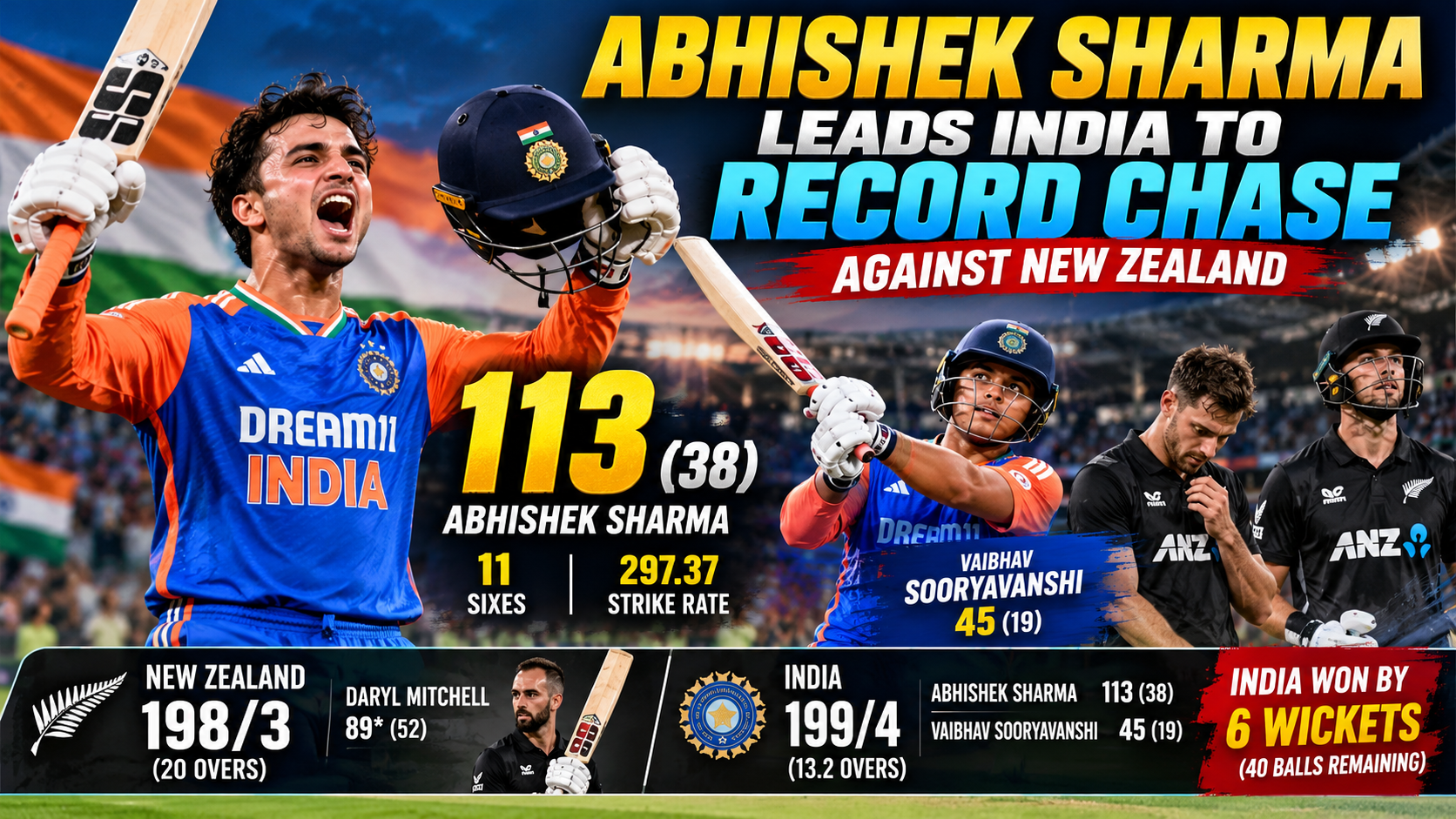
Abhishek Sharma delivered a breathtaking performance in Wellington, smashing 113 runs from just 38 deliveries to guide India to a six-wicket victory over New Zealand in the third T20 International. His fourth T20I century, combined with a blistering opening partnership alongside Vaibhav Sooryavanshi, helped India chase down 199 in only 13.2 overs and secure the series with two matches remaining.
Sooryavanshi contributed 45 runs from 19 balls as the pair added 133 runs in just 7.1 overs. New Zealand’s total of 198 for three proved nowhere near enough against India’s aggressive batting display.
Abhishek Sharma Shatters Powerplay Records
Abhishek came close to challenging his own record for the fastest T20I century by an Indian, reaching three figures in just 35 balls. He celebrated the milestone with a roar and a clenched fist before briefly sitting in a meditative pose.
His innings included 11 sixes and came at an extraordinary strike rate of 297.37. Although he fell short of his own 30-ball century record, his performance established another remarkable milestone for Indian cricket.
Abhishek also narrowly missed Yuvraj Singh’s famous record for the fastest T20I half-century by an Indian, reaching his fifty in 15 balls rather than 12.
India’s most significant achievement came during the Powerplay. The visitors raced to 118 runs in the first six overs, setting a new record for the highest Powerplay total in a T20 match between Full Member nations.
By the time the opening partnership ended, India required only 66 runs from 77 balls. They completed the chase with 40 balls remaining, despite losing a few wickets towards the end.
Vaibhav Sooryavanshi Makes an Immediate Impact
India made a notable change at the top of the batting order, promoting teenage opener Vaibhav Sooryavanshi ahead of Sanju Samson. The decision paid off almost immediately as the youngster attacked New Zealand’s bowlers from the beginning.
Sooryavanshi struck Jacob Duffy for a boundary over mid-on before launching another delivery over point for six. Abhishek responded by sending his first ball over the boundary, marking the eighth occasion on which he had hit a six off his first delivery in a T20I.
India had already accumulated 26 runs after the opening over, setting the tone for an extraordinary chase.
Adam Milne conceded 17 runs in the second over, while Michael Bracewell’s off-spin went for 21. Kyle Jamieson then gave away 20 runs, including two sixes and two fours.
Abhishek reached his half-century in just 15 deliveries, and India crossed the 100-run mark before the fifth over had finished.
New Zealand struggled to contain the two left-handed batters, repeatedly offering deliveries that could be attacked through the off side. Mitchell Santner, who had been among the most economical bowlers during the series, was not introduced until the ninth over. By that stage, India had already scored 156 runs.
Although New Zealand managed to take a few wickets late in the innings, the result was never seriously in doubt.
New Zealand Build a Competitive Total Through Daryl Mitchell
Before India’s explosive response, New Zealand had produced a strong batting performance of their own, finishing on 198 for three in 20 overs.
India captain Shreyas Iyer won the toss for the third consecutive match and his bowlers began with two economical overs. Arshdeep Singh then dismissed Tim Seifert, repeating a pattern from the previous encounter in Christchurch. The left-arm pacer angled the delivery across the right-hander, who edged a cross-batted shot into the air.
New Zealand recovered quickly after adjusting to the unusual bounce at the venue. Bhuvneshwar Kumar conceded two sixes in his second over, while Arshdeep gave away 15 runs in the sixth as the hosts reached 58 in the Powerplay.
Finn Allen and Daryl Mitchell continued the attack, striking two sixes each against Axar Patel and Prince Yadav.
Nitish Reddy helped India regain control with a disciplined over that cost just six runs and included Allen’s dismissal. His approach also demonstrated the importance of bowling towards the longer straight boundaries, which measured approximately 56 and 62 metres on the square.
India’s bowlers subsequently relied more heavily on yorkers and fuller deliveries to restrict the scoring opportunities.
Mitchell, however, remained difficult to contain. He used clever ramps against fuller deliveries, moved outside his crease to disrupt the bowlers’ lengths and punished shorter balls over the relatively short boundaries.
His unbeaten 89 came from 52 balls and included five sixes and five fours, representing the highest individual T20I score of his career at the time.
Despite Mitchell’s impressive innings, India’s extraordinary batting display ultimately overshadowed New Zealand’s efforts.
India Seal the T20I Series in Dominant Fashion
The result gave India another convincing victory and secured the series with two matches still to play. Abhishek Sharma’s remarkable century and the record-breaking Powerplay transformed what appeared to be a challenging target into a one-sided contest.
Sooryavanshi’s aggressive contribution also highlighted India’s batting depth and the impact of promoting young talent into key positions.
For the latest cricket scores, match reports and international cricket updates, visit Live Cricket Score.
Match Summary
- New Zealand: 198/3 in 20 overs
- Top scorer: Daryl Mitchell — 89 not out off 52 balls
- India’s best bowler listed: Arshdeep Singh — 1/33
- India: 199/4 in 13.2 overs
- Top scorer: Abhishek Sharma — 113 off 38 balls
- Other key contribution: Vaibhav Sooryavanshi — 45 off 19 balls
- Result: India won by six wickets, with 40 balls remaining.